top of page

Updated: May 11, 2023

If you've read my book, Written in the Stars: Poems and Pictures or if you know me personally, you already know that I often turn to astrology, numerology and tarot to help me with self-understanding. I'm also adding Human Design to my esoteric toolbox, but that will be a post for another day.


At this writing, the Sun is in Taurus and the Moon is in Capricorn, both Earth signs which can help us to feel grounded when life circumstances may dictate quite the opposite. The recent lunar eclipse in the sign of Scorpio left me feeling a bit untethered emotionally. So much so that I realized it was time to free myself of a writing project that I started 18 months ago, but no longer excites me. I knew deep down (thanks to a natal 9th house stellium in Scorpio sitting next to the eclipse) it was time to let it go, but I kept trying to force it into something it just didn't want to become. So I put down my pen and closed my notebook on that project for now. It has taken me 5 days to come back to Earth (so to speak) and operate on a more even keel.


The Venus-ruled sign of Taurus invites us to notice the beauty all around us. Taurus governs that which we value including love and money; it rules the throat chakra enabling us to praise, sing, lend our voice to what needs to be expressed. A very sensual sign, Taurus has good taste and appreciates the finer things in life. Yet it is a fixed sign...unwavering, steady...and yes, stubborn. One can depend on the steady rhythm of strong Taurean energy, finding comfort in the familiar.


That being said, I've always enjoyed writing haiku, the Japanese-born 3-stanza poems featuring 5 syllables in the first line, 7 syllables in the second line and 5 syllables once again in the last line of the poem. 5-7-5. My 12th house Saturn in Capricorn loves to work with this structure. And now with the Sun in Taurus, I'm in sync with the rhythm of haiku. It's comfortable, familiar. Perhaps it's my offbeat way (Aquarius Rising) that I self-soothe.


I will share a few recent poems.


Waiting to be born

The gestation period

May be very long


Ever the late bloomer, I wrote the above haiku realizing that at age 61, perhaps I have not yet begun to produce my best work. Thinking about Grandma Moses and others who didn't even begin to offer their creations to the world until later in life, perhaps the best is yet to come.


I recently was gifted The Wild Unknown Animal Spirit oracle card deck by Kim Krans and it's one of my favorite decks to work with especially when I need to hear my intuition come through. This morning, asking about the need for some things to change in my life, I received these two cards, Nightingale (fearless voice) and Phoenix (transformation of our past), pictured next to the resulting haiku I wrote.


When nightingales sing

Let their music transform you

With Phoenix-fueled flames


Sometimes I use the Rider-Waite tarot deck and do a reading for myself by asking a question (usually just wanting some guidance for the day) and selecting one card. Here's a haiku I wrote for the VI of Swords.


It's time to let go

Of what no longer serves me

I sail towards the light


I find it healing to use these haiku as affirmations to peek at throughout the day, for use as a mantra in meditation or as a quick pick-me-up.


5-7-5.


This is a story about a Bohemian rhapsody. Not the anthem made famous by Queen in the 1970s, but a recent discovery in my family history that is music to my ears! I have a strong paternal line composed of two families, The Kroc’s and The Pacovsky’s, both hailing from the ancient kingdom of Bohemia. For geography buffs, Bohemia once occupied the land in what is now the western part of Czech Republic.


The name on my birth certificate is Diane Krutz, but my surname originated as Kroc back in Bohemia. I later learned that Kroc was changed to Krotz and eventually to Krutz by my ancestors once they were settled in western Pennsylvania. Between the research done by family members as well as that discovered more recently online, I can trace the Kroc line back to 1772, at the birth of my 4th great-grandfather, Jan Kroc in Přívětice, Radnice, Bohemia.


On the Pacovsky branch of my family tree, I long believed that my 2nd great-grandparents were Frantisek and Barbara Pacovsky as they were enumerated in the 1880 census. Emigrating from Bohemia around the year 1866 with their young daughter, also named Barbara and possibly a son, Joseph in tow, the census shows them living in Plum Township along with three more daughters born after they arrived in Pennsylvania; Mary (my great-grandmother), Josephine and Anastasia or “Annie” as she was known. I have yet to find a ship’s passenger list announcing their arrival in America.

Talk about butchering a last name! Pacovsky was spelled Busepkey by an 1880 census taker.

For years, my 3rd cousin, Jayne (who I have come to know through her extensive research of the Pacovsky line) and I have tried to uncover the maiden name of our 2nd great-grandmother, Barbara as well as more information about Joseph who was named in the census, but has never shown up anywhere else. Jayne’s great-grandmother was Barbara Pacovsky Wildman, the eldest daughter of Frantisek and Barbara Pacovsky. We assumed that mother Barbara and son Joseph died before May 1897 as neither was mentioned in the Last Will and Testament of our 2nd great-grandfather Frantisek. Thanks to Jayne’s recent inquiry to the Diocese of Pittsburgh, we learned this week that Barbara Pacovsky was not our 2nd great-grandmother after all! She was Frantisek’s 2nd wife!


According to marriage records obtained from the Diocese, our 2nd great-grandmother’s name was Maria Sisték, also from Bohemia. She and Frantisek are listed as parents at the marriages of daughters, Josephine Pacovsky, married to Phillip Corcoran on November 26, 1890 at St. Joseph Parish in Verona, Pennsylvania; and Mary Pacovsky (my great-grandmother) married to Frantisek Kroc (my great-grandfather) on August 18, 1891 at St. Wenceslaus Roman Catholic Church, located on Pittsburgh’s North Side.


Records obtained from Diocese of Pittsburgh. Note the Latin spelling of names.

St. Wenceslaus’ Death Register reveals that Maria Sisték Pacovsky died on April 24, 1873 and was buried the next day at St. Mary’s cemetery, now Christ Our Redeemer Cemetery in Pittsburgh.* Only three months later, the Marriage Register confirms that Frantisek married Barbara Rĕřabek, the Barbara in the 1880 census. Furthermore, the church’s baptismal records show that Barbara Rĕřabek is the mother of the youngest Pacovsky daughter, Anastasia, born on April 9, 1874. One can naturally surmise that Frantisek, a widower with three (possibly four) young children in 1873, would want to remarry as quickly as possible. I can only imagine my great-grandmother as a bereft 5-year-old alongside her other young siblings who had just lost their mother.


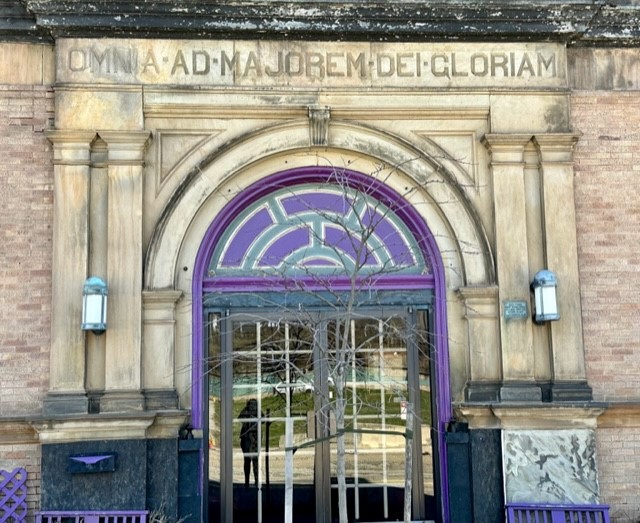
Interestingly, St. Wenceslaus was the only Bohemian parish in the Pittsburgh region. Founded in 1871 by a group of Bohemian immigrants, the church was replaced in 1900, but closed its doors in 1989. Knowing this makes me wonder if the Pacovsky family attended weekly Mass at this church or did they use the church only for weddings, baptisms and funerals. The family home was approximately 15 miles from St. Wenceslaus, quite a distance to travel to and from church every Sunday in those times. Pictured below are views of St. Wenceslaus today.


Discovering new information about your family history is like listening to your favorite song all these years then one day realizing that the lyrics you’d been singing this whole time were totally wrong, but nonetheless you’re happy and relieved to now know the right ones. And on that note, I have quite a few more lyrics to figure out.


*I’m not contesting the findings of the Diocese of Pittsburgh necessarily, but at this writing and upon further research, I have not yet connected a St. Mary’s cemetery from 1873 that was later renamed Christ Our Redeemer, as the latter appears to have been founded in 1888 as the Redemptorist Fathers and St. Philomena Parish Cemetery in Pittsburgh. As with most family mysteries, once one is solved, another one invites you to begin a new investigation.


Today is International Women's Day, recognizing and celebrating the achievements of women all over the world. Many of us are quick to play small and not acknowledge our own achievements believing that only those women in the news who do great things are worthy of these commendations. But I find that this particular day is the perfect time to honor the women who made it possible for me to be here today.


Stella Habucky Krutz a.k.a. my mother

My mother, pictured above, was a woman of many achievements although she'd be quick to say that she didn't do anything special. She was an excellent student, Secretary of her Senior class in high school, and Editor of the school newspaper. Her parents could not afford to send her to college so she became a secretary at Family Finance in 1949 and worked there until she gave birth to me in 1961. After I graduated from college, my mother went back to work as a co-owner with my father of our family's jewelry store. Throughout her life we often talked about us both longing to be published writers. Shortly after her death in 2020, I found an incredible short story she'd written stuffed in the back of a bedroom dresser drawer. I will publish it posthumously one day soon. The name "Stella" is derived from the Latin word for "star." She certainly was a star in my book.


My grandparents on my parents' wedding day, July 1958.

I was blessed to know both of my grandmothers (pictured above) until they died exactly two weeks apart in June 1999. Ann Suchar Krutz, on the left and Anna Beitko Habucky, on the right, brought so much love, luck (Grandma Krutz was a frequent winner at Bingo) and good Polish cooking (Grandma Habucky made the best halupki) to my life. Both women were born in the US and took charge of the household as most women did in their day. One of my biggest regrets is not asking them more questions, especially about their own upbringing. Where did their parents come from? What did they know about their grandparents?


Mary Pacovsky Krotz, my paternal great-grandmother, surrounded by her children.

Mary Murzyn Beitko, my maternal great-grandmother.

I never knew any of my great-grandparents, but I do have photos of two of my four great-grandmothers, pictured above. Mary Pacovsky Krotz was born in 1868, a few years after her family arrived here from Bohemia. She married my great-grandfather, Frantisek Kroc, in July 1891 and they raised five children together. I have a few more details about her on my Ancestry.com family tree and plan to write more about the Pacovsky line as I've recently learned more about her father, my great-great-grandfather, Frantisek (Frank) Pacovsky. With respect to my other paternal great-grandmother, Martha Muchichka Suchar, I only know her name and a few select details discovered on website searches, but she is ever on my radar.


On my maternal side, Mary Murzyn Beitko was born in 1877 in Russia Poland according to an early census record. My mother told me that her grandmother was a tiny woman who walked very fast. I don't believe she knew any English, but as children, my mom and her siblings seemed to understand what she said. She arrived in the US with two daughters in tow...I believe my great-grandfather was already here...and they had 7 more children together before her death in 1949. My other maternal great-grandmother was Mary Holody Habucky. I italicized her maiden name because I'm not 100% sure that it is correct. On my grandparents' marriage license, my grandfather's mother's birth name is written as Notody, but an extensive search has turned up nothing on that name. However, I have many DNA cousins with the last name Holody. This line is another ongoing search.


Without these amazing women and the ones who came before them, I would not be able to celebrate them here or at all. Knowing the little I have learned about my ancestors humbles me. Their lives had to be much more challenging than mine. They faced war and poverty and probably other fears that I could only imagine; however, they survived it all. They crossed an ocean, and worked hard to create a new life for themselves and their families. Today may be International Women's Day, but I honor these women everyday.


© 2021-2026 Diane DiCola

bottom of page